

Mobile devices are not supported temporarilyPlease go to the PC terminal to use it


 EN
EN IP Deep
 2026-01-05 18:00
 Dynamic Residential
For those engaged in cross-border e-commerce, data collection, advertising delivery, and social media management, using proxy IPs for access is a common practice. In fact, many websites cannot be accessed without a proxy. Some people who use proxies often find that dynamic residential IPs are highly recommended, which may lead to a lot of questions about them.
Today, we will give you a concise yet in-depth explanation of what dynamic residential IPs are, why so many people recommend them, and how they differ from other types of proxy IPs.
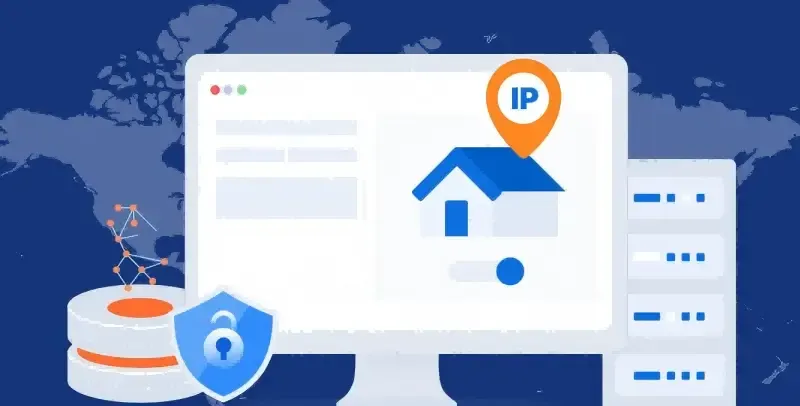
Simply put, a dynamic residential IP is a broadband connection from a real household, but the IP address is subject to changes.
Residential IP: The IP originates from a real home network, such as broadband services provided by telecom operators like China Telecom, China Unicom, China Mobile, or other ISPs.
Dynamic: The IP address is not fixed; it will automatically change after a certain period of use, which may be after a few minutes, tens of minutes, or several hours.
When we use dynamic residential IPs, we generally value the fact that they are real residential IPs. After all, on websites with strict detection mechanisms, irregular IPs will be directly identified as bots, resulting in account bans or operation restrictions.
Before choosing an IP, let's first understand several common types of IP addresses.
| Comparison Dimension | Data Center IP | Static Residential IP | Dynamic Residential IP |
|---|---|---|---|
| IP Source | Data Center Servers | Real Household Broadband | Real Household Broadband |
| IP Variability | Basically Fixed | Long-term Fixed | Automatically Changed Regularly |
| Detection Risk | High, Easily Detected | Low | Very Low |
| Applicable Scenarios | Low-risk Control Scenarios, Testing | Core Accounts, Long-term Operations | Multi-account Management, Social Media, E-commerce Testing |
Data Center IPs are suitable for: Scenarios with low account detection sensitivity, where only network speed is a priority.
Static Residential IPs are suitable for: Long-term account login and store operation.
Dynamic Residential IPs are suitable for: Data collection, batch operations, and multi-account environments.
In recent years, e-commerce platforms and social media have begun to implement IP-based identification. If the same IP repeatedly accesses a website or the IP originates from a concentrated data center, it will be directly identified as abnormal behavior. This usually leads to account restrictions, function limitations, or even permanent bans.
Dynamic residential IPs come from real households, and each IP switch represents a new access identity. They are most suitable for auxiliary operations, while static residential IPs are better for long-term operations.
Real users often switch networks and use different IPs at different times. Dynamic residential IPs simulate this real user behavior, which appears more natural to platforms.
If a static IP is flagged by a platform, all associated accounts and data may be affected. Dynamic residential IPs allow you to switch to a new IP immediately if one is compromised, avoiding the risk of mass account bans due to shared IP associations.
For search engine crawling, e-commerce price monitoring, and public opinion tracking, dynamic residential IPs can effectively avoid 403 errors, CAPTCHA challenges, and IP bans.
For multi-store management, IP testing in different countries, and ad material review, residential IPs are more likely to pass platform authenticity verification.
For rapid promotion of multiple accounts on Facebook, TikTok, and Instagram, combining dynamic residential IPs with fingerprint browsers has become an industry-standard solution.
Dynamic residential IPs provide a network environment that closely mimics real users. As platform risk control becomes increasingly strict, choosing and configuring the right IP is crucial. By selecting a high-quality proxy provider like IPDEEP and matching it with a suitable anti-detection browser for environment configuration, you can significantly reduce account risks and improve work efficiency.
Under normal circumstances, no. Reputable dynamic residential IP providers like IPDEEP filter IPs for quality and availability. IP switching is a protective measure, not a sign of unstable network connections.
Technically speaking, platforms cannot distinguish between a dynamic residential IP service and a home network connection. They can only recognize the access as coming from an ordinary user with a real residential network.
Not exactly. Dynamic residential IPs are a type of proxy IP, but their key features are that they originate from residential networks and change dynamically. Regular proxy IPs may be data center IPs or low-quality shared IPs, and there is a significant difference in security between the two.